Good workplace communication should make work easier, not more confusing.
Employees need to understand what is expected, how to ask questions, where to go for support, and what success looks like. That is important for every employee, but it can be especially helpful when managing neurodivergent team members.
Neurodivergence can include autism, ADHD, dyslexia, dyspraxia, Tourette syndrome, and other differences in how people process information, communicate, focus, learn, and work.
The key thing to remember is this: knowing someone’s diagnosis does not mean you know how they work best.
Two autistic employees can have completely different communication preferences. Two people with ADHD may use completely different systems to organize their work. One employee may want detailed written instructions. Another may prefer a quick conversation.
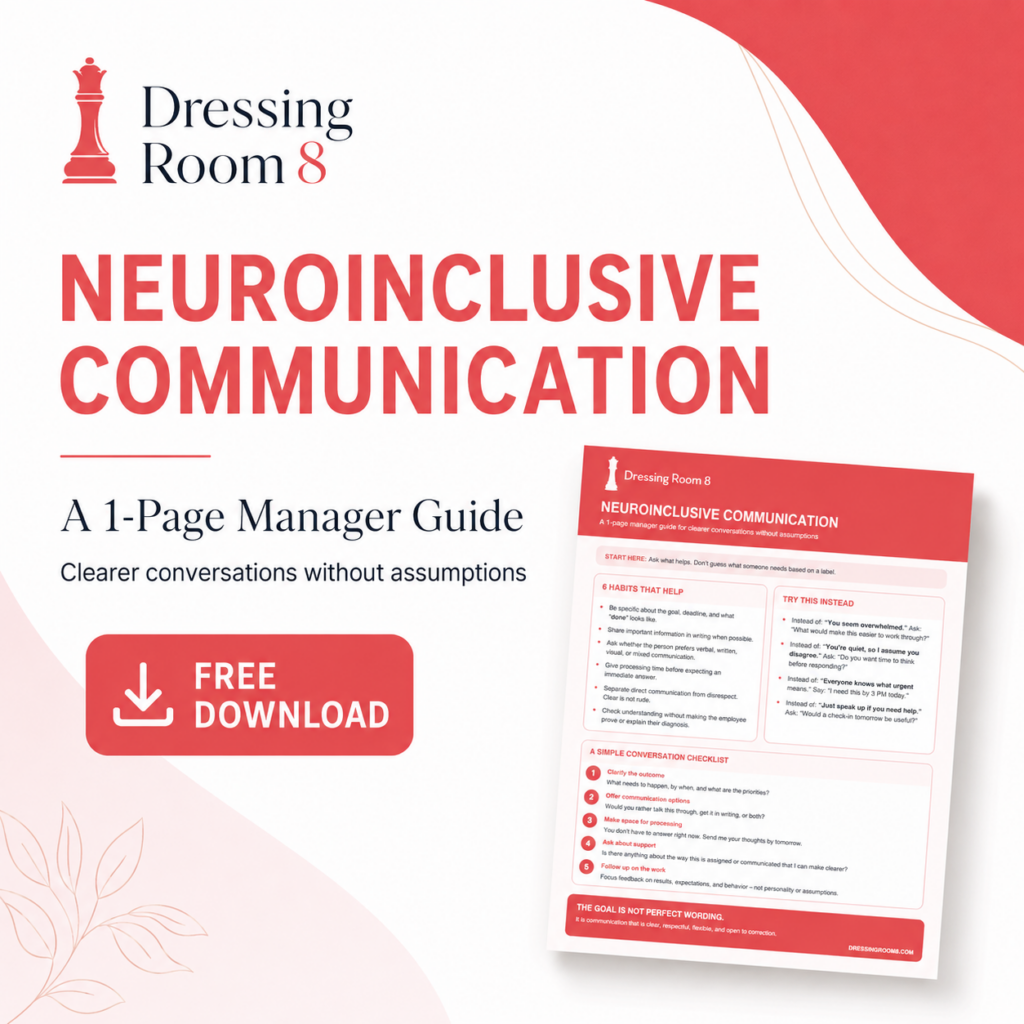
Instead of guessing, build a simple habit into your management style:
Ask. Clarify. Stay flexible.
A diagnosis may provide context, but it does not tell you everything about a person.
Avoid assumptions like, “They have ADHD, so they must need constant reminders,” or “They are autistic, so they probably do not like meetings.”
Ask about what helps them do the work instead.
You might say, “What helps you get clear on a new assignment?” or “Do you prefer feedback in writing, in conversation, or both?”
You can also ask, “Is there a communication style that helps you work more effectively?”
These questions focus on the employee’s needs without requiring them to explain or defend their diagnosis.
Vague workplace language creates unnecessary confusion.
“Get this to me soon.”
“Make this a priority.”
“Can you clean this up?”
What does “soon” mean? Today? Tomorrow? By the end of the week?
Instead, say, “Please send me the first draft by 3 PM on Thursday.”
If you want someone to improve a project, explain what needs to change. Should it be shorter? More detailed? More visual? More accurate?
Clear instructions remove the need to guess.
And that helps everyone.
People communicate differently.
Some employees make a lot of eye contact. Others do not.
Some enjoy small talk. Others would rather get straight to the point.
Some employees may ask several questions before starting a project because they want to fully understand the assignment.
A short response does not automatically mean someone is rude. Limited eye contact does not mean someone is not listening. Clarifying questions do not necessarily mean someone is challenging your authority.
Before reacting, ask yourself:
Am I responding to the employee’s actual behavior and work, or am I reacting because they communicate differently than I expected?
That distinction matters.
Not everyone processes information at the same speed or in the same way.
Some people can hear a question and immediately explain exactly what they think. Others need time to organize their thoughts before responding.
When possible, send meeting agendas ahead of time. Share important questions before the meeting. Give people an opportunity to respond afterward.
You can simply say:
“You do not have to answer right now. Think about it and send me your thoughts tomorrow.”
Giving someone processing time does not lower expectations. It can actually help you get a more thoughtful response.
Verbal conversations can include a lot of information at once.
Deadlines change. Priorities shift. New responsibilities get added.
A short written follow-up can prevent confusion.
After a conversation, you might send:
“Quick recap: You are handling A and B, I am handling C, and we will review the draft Friday at 10.”
That message gives everyone something to refer back to later.
You do not need to write a long email after every conversation. The goal is simply to make important expectations easy to find.
Do not wait until an employee is overwhelmed or falling behind to ask what would help.
Make conversations about support part of everyday management.
Useful questions include:
- “Is there anything I can make clearer?”
- “Would a written example help?”
- “Would you like me to check in tomorrow, or would you prefer space to work?”
- “Is there a better way for me to communicate project changes?”
When managers ask these questions regularly, employees do not have to wait until there is a problem to speak up.
Support becomes part of how the team works.
Feedback should tell someone what happened, what needs to change, and what is expected moving forward.
“You seem disengaged” is unclear.
Instead, say, “You missed the last two project updates. Going forward, I need a status update by noon on Tuesdays and Thursdays.”
“You need to be more professional” is also vague.
Instead, identify the specific behavior you want changed.
For example: “During client calls, please wait until the speaker finishes before responding.”
Concrete feedback is easier to understand and easier to act on.
You do not need to memorize a different set of communication rules for every neurotype.
You also do not need to become an expert in someone else’s brain.
You need to create enough flexibility for employees to tell you what helps them work successfully.
Be clear about expectations. Ask instead of assuming. Give people time to process. Put important information in writing. Focus feedback on the work. And stay open to adjusting your approach when something is not working.
Neuroinclusive communication is not about lowering standards.
It is about removing unnecessary confusion so employees have a fair opportunity to understand the expectations, contribute their ideas, and do their best work.
That is not just good neuroinclusive leadership.
That is good management.